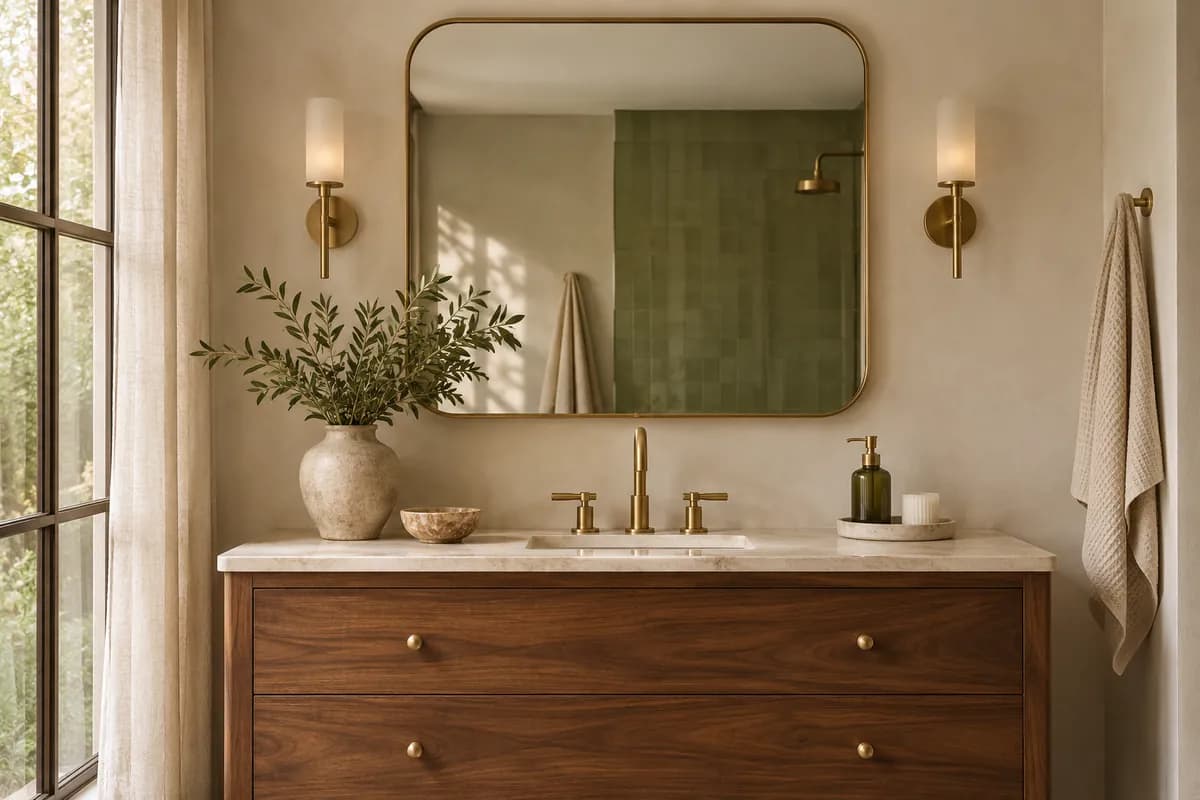
The useful bathroom mirror is the one that fits the vanity wall and supports the way people use the sink. Measure the vanity, faucet, lighting, and available height before comparing shapes. A mirror’s listed width alone does not tell you whether its frame, mounting hardware, light, or medicine-cabinet depth will work in the room.
Measure the vanity and available wall
Measure the vanity’s finished width, then measure the open wall from the countertop to the bottom of the light fixture, cabinet, or other obstruction. Record the faucet height, backsplash height, side walls, and any trim. These dimensions define a practical envelope for the mirror; they are more reliable than choosing a size from a product photograph or a generic rule of thumb.
KOHLER’s mirror guide suggests a mirror above a vanity is typically narrower than or the same width as the vanity, and it recommends measuring the distance between lights and faucet. Treat that as a manufacturer’s planning suggestion, not a universal ratio. A narrow wall, double basin, medicine cabinet, or side-mounted sconce may change the useful proportions.
Sources: KOHLER: Mirrors Buying Guide
Choose a width for one or more basins
For a single basin, compare the mirror’s outside width with the basin, faucet, and vanity edges. For a double vanity, decide whether one long mirror or two separate mirrors better serves the people using the sinks and the lighting arrangement. Mark both options on paper and review them from standing and seated positions if those are part of the household’s routine.
A single wide mirror may visually connect a double vanity, while two smaller mirrors can create a clearer relationship with individual basins or sconces. Neither arrangement is inherently correct. Keep enough space for the frame and installation hardware, and check that the mirrored surface will not collide with wall cabinets, towel bars, or adjacent doors. Also mark the faucet centerline and any backsplash termination; a mirror centered on the cabinet may not align with an offset sink or existing plumbing.
Set a comfortable height around faucet and light
Measure from the countertop to the fixture or cabinet above, then compare the mirror’s actual outside height and hanging hardware. Leave room for faucet operation, cleaning, and a comfortable reflection. If the mirror has a thick frame, account for its full dimensions rather than only the glass. A paper outline helps test how the height feels for the people who use the room.

Bathroom lighting can create shadows or glare depending on its position and the mirror surface. Check the planned arrangement with the actual lights switched on, and review the reflection from the normal standing place. For a broader lighting decision, use the bathroom vanity lighting guide; this article is about mirror size and does not determine electrical suitability.
Compare mirror, medicine cabinet, and storage needs
A flat mirror offers a reflective surface with little depth, while a medicine cabinet adds storage and may be surface-mounted or recessed. Measure the wall cavity and check for framing or services before considering recessed installation. A cabinet door needs clearance to open, and its shelves must suit the items you intend to store.
Use the exact product’s installation guide to confirm its overall dimensions, depth, weight, hinge direction, and required wall support. Do not assume that two products with the same front width have the same clearances. If the wall contains plumbing or wiring, or the installation requires cutting into it, consult a qualified installer before work begins.
Account for frame shape and the rest of the room
A round or arched mirror can soften a room with many straight lines, while a rectangular form may echo the vanity and tile layout. Compare the outside shape with the faucet, basin, lights, and wall joints. The goal is to make the mirror feel related to the fixtures without forcing every line in the room to match.

Check the mirror against the tile pattern and grout lines from the room entrance. A frame may cover a useful tile edge or appear slightly off-center even when it is centered over the vanity. Make a taped outline at the exact dimensions, then review the result in daylight and with the room lights. Personal comfort and the actual wall should guide the final choice.
Check mounting weight and wall construction
Before buying, find the mirror’s full weight, hanging method, hardware supplied, and wall-type requirements. A framed mirror or medicine cabinet may be much heavier than its size suggests. The correct fastener depends on the product, wall construction, and attachment points; the product photo cannot establish what is behind the wall or what a fastener can safely hold.
Follow the mirror and hardware manufacturer’s instructions and local requirements. If the wall material is unknown, the mirror is heavy, or the mounting points do not line up with appropriate support, ask a qualified installer. Do not use adhesive strips or a generic anchor as a substitute unless the exact manufacturer explicitly approves that method for the product and wall.
Sources: C.R. Laurence: Mirror Hanger Installation Instructions
Plan lighting, outlets, and moisture exposure
Map light fixtures, outlets, switches, ventilation, and plumbing access before choosing a final location. Keep required access clear and check whether a lighted mirror has specific location ratings, electrical connections, and clearances. A mirror that includes lighting or power is an electrical product; its listing and installation instructions control suitability for the bathroom location.

Do not infer electrical or moisture suitability from a staged bathroom image or a generic product category. Verify the exact model’s markings and manual, and have electrical work handled by a qualified professional. If condensation or frequent splashing is expected, confirm the maker’s cleaning and care guidance for the glass, frame, and electronics.
Mock up and verify the exact model
Tape the measured outline in place, then check it from the sink, doorway, and adjacent route. Open cabinet doors, stand where each person normally uses the mirror, and verify that the frame will not crowd the light or faucet. For a double vanity, test the sightline for both basins rather than checking only the center of the room.
Before checkout, confirm the selected model, outside dimensions, glass dimensions, weight, frame finish, mounting kit, return terms, and delivery condition. If the listing omits a detail that affects fit or installation, ask the manufacturer or seller. For an entryway mirror, use the separate entryway placement guide; those sightlines and mounting conditions differ from a bathroom vanity.
Conclusion
Choose a bathroom mirror after measuring the vanity, available wall height, faucet, and lights. Test the outside dimensions in place and verify the exact model’s weight, mounting, care, and electrical details if it is illuminated. Ask a qualified installer about uncertain wall support or electrical work; proportion suggestions are not installation specifications.
Frequently Asked Questions
Should a bathroom mirror be as wide as the vanity?
Measure the vanity’s finished width, then measure the open wall from the countertop to the bottom of the light fixture, cabinet, or other obstruction. Record the faucet height, backsplash height, side walls, and any trim. These dimensions define a practical envelope for the mirror; they are more reliable than choosing a size from a product photograph or a generic…
How much space should be between a mirror and faucet?
Measure from the countertop to the fixture or cabinet above, then compare the mirror’s actual outside height and hanging hardware. Leave room for faucet operation, cleaning, and a comfortable reflection. If the mirror has a thick frame, account for its full dimensions rather than only the glass.
How do I mount a heavy bathroom mirror?
Before buying, find the mirror’s full weight, hanging method, hardware supplied, and wall-type requirements. A framed mirror or medicine cabinet may be much heavier than its size suggests. The correct fastener depends on the product, wall construction, and attachment points; the product photo cannot establish what is behind the wall or what a fastener can safely hold.
Should I choose one mirror or two for a double vanity?
For a single basin, compare the mirror’s outside width with the basin, faucet, and vanity edges. For a double vanity, decide whether one long mirror or two separate mirrors better serves the people using the sinks and the lighting arrangement.
How do I check whether a lighted mirror suits a bathroom?
Map light fixtures, outlets, switches, ventilation, and plumbing access before choosing a final location. Keep required access clear and check whether a lighted mirror has specific location ratings, electrical connections, and clearances. A mirror that includes lighting or power is an electrical product; its listing and installation instructions control suitability for the bathroom location.
Sources and further reading
We link primary or institutional references near factual claims and list the sources used for this guide below. Design suggestions are editorial guidance, not universal rules.
Living Statement may earn a commission from some partner links. Any paid relationship will be disclosed close to the relevant offer. How our affiliate links work.